Staring into my bathroom mirror, I find myself thinking about the effects of toxic beauty standards. At this hour, only the truly unhinged or those recovering from a Criminal Minds marathon are awake. I am both.
My reflection doesn’t offer the consolation I seek. I mentally enumerate some deficits: thick, asymmetrical brows, pores that look like miniature craters, and a jawline that has seen better days.
The effects of toxic beauty standards are evident in the many virtual and in-person interactions I witness. This is how I try to defy them.
Why are we obsessed with the ‘Blackpill’ and ‘Hardmaxxing’?
The effects of toxic beauty standards are particularly visible in the rise of looksmaxxing, the extreme physical optimisation of one’s face and body to climb the social ladder.
Meanwhile, within the darker corners of the manosphere’ lies the blackpill ideology. It’s a fatalistic worldview suggesting that your romantic success is dictated solely by your genetics.
If you aren’t a “Chad”—the mythological archetype of the symmetrical, hypermasculine God—you are encouraged to hardmaxx. This does not mean getting a nice haircut or a splash of Revlon. It means surgery-maxxing to fix an incel-type face. It’s as if the human form is merely a software project in need of an extreme patch.
What is the biggest problem in the beauty industry?
The beauty industry is a transformer that plugs into our insecurities and converts them into billions of dollars in revenue. These companies keep us in a state of normative discontent. Hence, hating our bodies has become a standard hobby. They sell us holy oils with pseudo-scientific names but are actually just overpriced wool grease.
Worse still, the industry is riddled with a lack of transparency. We are lathering ourselves in endocrine-disrupting phthalates and parabens.
In Nigeria, studies found lipsticks contaminated with toxic metals like lead, cadmium, and chromium. Meanwhile, in Ghana, 40% of the female population uses synthetic hair extensions. This practice generates 167 tonnes of waste annually. It releases carcinogenic volatile compounds and microplastics that could likely survive a nuclear winter.
Who is most affected by beauty standards?
When the effects of toxic beauty standards hit Gen Z and Gen Alpha before they’ve even cleared puberty, we have to admit the sky is falling. Nine-year-old girls are already dieting because they feel too fat. It’s heartbreaking. For these kids, being beautiful is a dopamine-driven compulsion monitored by the quantification of social approval.
While 85–90% of cosmetic spending still comes from women, men are rapidly being colonised by the same anxieties. A third of men now seek surgical procedures, and 10% of college students with eating disorders are male.
We’ve also exported a highly Westernised, Eurocentric white beauty ideal across the globe. Women in Asia and Africa now spend $23 billion annually on skin-lightening creams.
What are the consequences of chasing beauty standards?
Toxic beauty standards lead us to assess our bodies like a collection of car parts for sale. This constant surveillance is exhausting.
I think of “Artemis,” a teenage girl Renee Engeln interviewed, who felt her lack of skinniness “ruined it all,” even though she was brilliant at science. She was “beauty sick.” When your emotional energy is so bound up in the mirror, it becomes impossible to think of anything else.
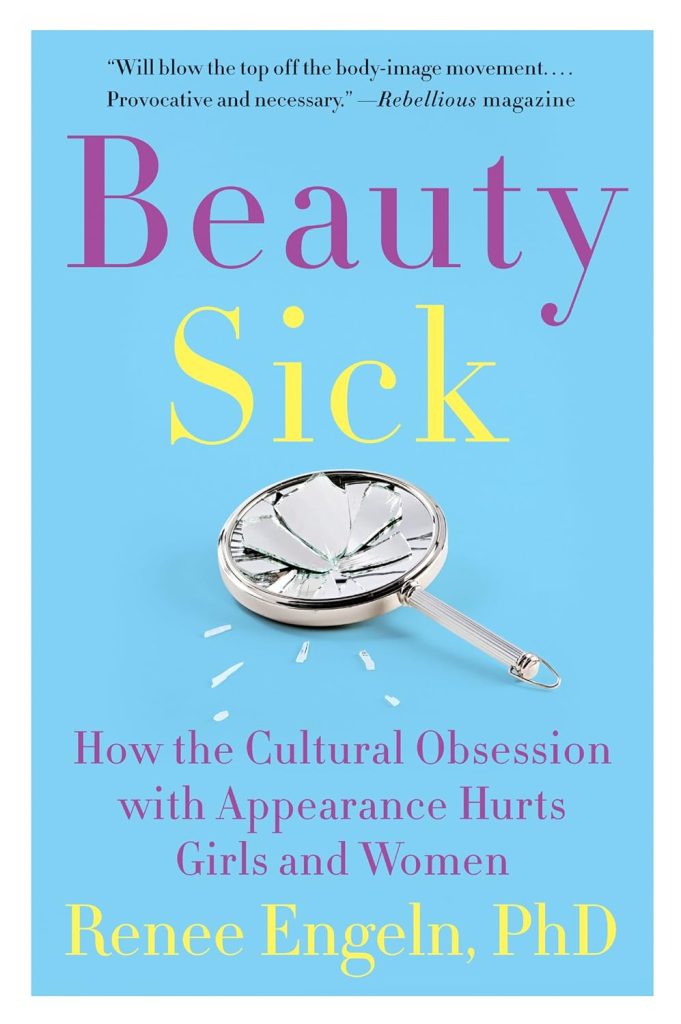
Beauty Sick reveals how our obsession with appearance steals the time, money, and mental energy we need to pursue our dreams and live fully. Through scientific research and real-life stories, Engeln demonstrates that overcoming this affliction requires dismantling the inner thoughts that fuel depression, body shame, and self-objectification.
Read this book to discover the solutions needed to reject toxic beauty standards.
The literal physical harm, such as “bone-smashing”—a trend where boys strike their own facial bones to “improve” structure—is one of the more terrifying effects of toxic beauty standards.
Skyrocketing rates of anorexia and social anxiety are also a direct testament to this phenomenon. We spend $15,000 in a lifetime on makeup, money that could have paid for a university degree or at least a very nice Maldivian getaway.
Do attractive people have better mental health?
Even those labelled PSL Gods aren’t immune to the effects of toxic beauty standards. Research shows that the happiest people are no more attractive than the average ones. Being beautiful often means you have a more relevant standard of comparison to fail against.
Attractive people often struggle with body appreciation—valuing what the body does rather than how it looks. If you base your self-worth on something as fleeting as a youthful epidermis, you’re basically building a house on a geological fault line.
How do beauty standards affect relationships?
Beauty standards are the unwelcome third wheels in every first date, turning what should be a bit of fun into a high-stakes audit. According to the Marriage Market Theory and Selection Hypothesis, we’re all just trading on erotic capital like horny stockbrokers.
Interestingly, a woman’s BMI does not predict relationship success. But her perceived body image does.
But the real passion-killer is scrutiny. It lowers relationship satisfaction for both men and women. Emotional intimacy suffers when a partner focuses more on physical appearance.
The barrage of beauty pornography creates a fantasy gap between real-life partners. Men who fixate on these ghosts are unable to see the beauty in a real human nursing them when they’re sick.
In manospheric subcultures on TikTok, these effects of toxic beauty standards fuel deep misogynistic hostility. These guys frame romantic failure as a political injustice. They think feminism has over-empowered women to be too selective.
My advice? Stop acting like a high-court judge. The most successful relationships are those that appreciate rather than dissect.
Final Thoughts
We can’t pretend these toxic beauty standards don’t exist. They present themselves the moment we park in front of social media. We see them in family dinners and high school reunions.
We can rebel against the effects of toxic beauty standards by staring into the sea, holding a cocktail instead of a mirror. Focus on what your body does, like swimming or holding your man in a tight hug.
Refuse to engage in fat talk. Choose authenticity over perfection. And remember, today is always worth celebrating, even if your eyebrows are currently a disaster.
Leave a Reply