The Breville Barista Express vs Pro comparison highlights key differences between these two models. The Breville Barista Pro is a modern upgrade. It boasts a 3-second heat-up time and 30 grind settings. In contrast, the Breville Barista Express remains a classic and affordable option with analogue controls.
The Pro improves the home brewing experience with its digital interface and stronger steam power. The Express offers a simpler design, a favourite in Australian kitchens for years. Your choice will depend on whether you prefer the fast workflow of new technology or the hands-on feel of the classic model.
I’ve created this guide for home baristas ready to pull their first shot of espresso or upgrade an older machine. Knowing the key differences between these two types is vital for your long-term satisfaction. From my time running a coffee shop, I’ve learned that the best machine suits your morning routine, not just the one with the most features.
Read our Breville Barista Express vs Pro technical comparison and buyer’s guide for home baristas. Discover which fits your coffee routine.
What is the Difference Between Barista Express and Pro?
The main difference between these machines is their heating technology and user interfaces. The Barista Pro starts up in 3 seconds and has a digital display. In contrast, the Barista Express takes 30 seconds to start and uses an analogue gauge.
How does heating technology impact your workflow?
The Pro model’s ThermoJet technology improves on the Express’s older Thermocoil system. The Pro is ready to brew almost as soon as you flip the switch. While the Express works well for standard home use, the Pro brews shots and steams milk faster.
Both machines use PID (Proportional-Integral-Derivative) controllers. These maintain brew water between 90.5 and 96 °C. A PID is a digital controller that adjusts the heating element. This prevents temperature fluctuations that can burn your beans. Temperature stability is key for flavour consistency, and the Pro has a slight advantage. It offers more precise digital control, while the Express uses a reliable traditional setup.
Why does the number of grind settings matter?
The Barista Pro has 30 grind settings, offering more flexibility than the Barista Express’s 18. Adjusting the grind size is called “dialing in.” This process helps you achieve a perfect 25–35 second extraction time. With those extra 12 settings on the Pro, you can easily find the “sweet spot” for special roasts.
Both machines feature stainless steel conical burr grinders. These grinders maximise the coffee surface area for full flavour. Conical burrs are preferred in the best espresso machines because they produce less heat than blade grinders. This helps keep the delicate oils in your beans. I’ve noticed the Pro’s grinder is a bit quieter and faster, but both produce a high-quality, uniform grind for your daily flat white.
Is the Breville Barista Express Good for Beginners?
Yes, the Breville Barista Express is a great choice for beginners. Its easy layout and analogue pressure gauge give quick visual feedback. This helps new users learn the basics of espresso extraction without dealing with complex digital menus.
How Does the Breville Barista Express’ Analouge Gauge Help You Learn?
The Barista Express features an analog pressure gauge. This gauge shows if your grind and tamp create the right resistance. If the needle stays low, your grind is too coarse. If it’s too high, you’ve ground too fine or tamped too hard. This visual guide acts like a coach and is often easier for beginners than reading numbers on a screen.
Ease of use is a key part of the Express design. It has labelled buttons and a simple “push to grind” cradle. You don’t need to sift through digital menus to change shot volume or cleaning settings. I often recommend this machine to friends who want a café feel at home but don’t want to operate a computer every morning.
Forgiveness and Accessories for the New Barista
Breville Barista Express includes single and dual-wall filter baskets. This helps beginners achieve great results, even if they haven’t mastered the grinder yet. Dual-wall baskets (or pressurized baskets) create artificial pressure. This helps produce decent crema, even with pre-ground coffee or older beans. As your skills improve, you can switch to single-wall baskets for better control over extraction.
The machine comes with a full accessory kit. It includes the Razor™ dose trimming tool and a high-quality milk jug. This way, you can start brewing right away. You won’t need to rush back to the shop for a tamper or cleaning kit. Everything you need is in the box. This “all-in-one” approach is why the Barista Express has been a best-seller for over a decade.
Breville Barista Express Technical Metrics
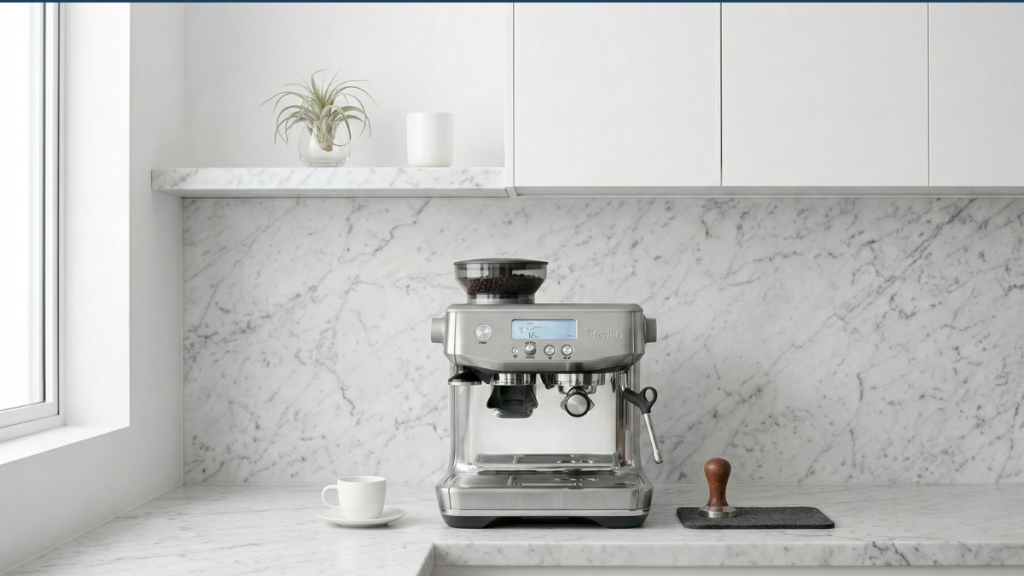
The Barista Express is a classic machine that combines analog aesthetics with solid performance. It’s one of the most durable and user-friendly options for home baristas on a budget.
| Metric | Benchmarking Result | Specification | Significance | Rating |
|---|---|---|---|---|
| Temperature Stability | Reproducible results | PID Control | Prevents sour/bitter shots | 4/5 |
| Start-up Time | Ready in ~30 seconds | Thermocoil System | Reliable home standard | 4/5 |
| Crema Quality | Thick and golden | 15-Bar Italian Pump | Visual proof of extraction | 4.5/5 |
| Microfoam Quality | Standard froth | 1-Hole Steam Wand | Requires more technique | 3/5 |
| Unit Width | Compact footprint | 33.5 cm (13.2 in) | Saves counter space | 4/5 |
| Unit Weight | Sturdy build | 10.4 kg (23 lbs) | Minimal shifting during use | 4/5 |
| Water Capacity | Large reservoir | 2.0 Litres | Fewer refills required | 4.5/5 |
| Noise Level | Standard buzz | Vibratory Pump | Impacts morning quiet | 3/5 |
| Ease of Use | Very intuitive | Analog Interface | Beginner-friendly | 5/5 |
| Maintenance | Manual alerts | “Clean Me” Light | Extends longevity | 4/5 |
Average Rating: 4.0/5
Summary Table of Technical Metrics: Barista Pro
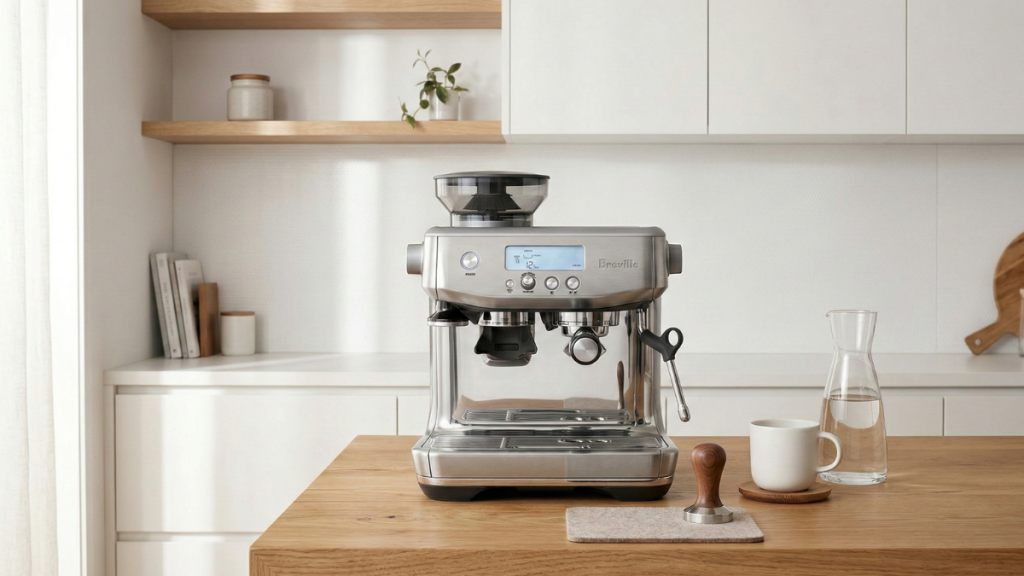
The Barista Pro is a top-notch machine made for speed and accuracy. It has great digital features and excellent milk texturing. This is perfect for anyone wanting a quicker morning routine.
| Metric | Benchmarking Result | Specification | Significance | Rating |
|---|---|---|---|---|
| Temperature Stability | Highly precise | Digital PID | Maximum consistency | 4.5/5 |
| Start-up Time | Ready in 3 seconds | ThermoJet System | Instant morning routine | 5/5 |
| Crema Quality | Rich and complex | 15-Bar Italian Pump | Professional standard | 4.5/5 |
| Microfoam Quality | Fine microfoam | 4-Hole Steam Wand | Faster latte art process | 5/5 |
| Unit Width | Slightly wider | 35.3 cm (13.9 in) | Fits most kitchens | 4/5 |
| Unit Weight | Solid construction | 10.9 kg (24 lbs) | Does not move on bench | 4.5/5 |
| Water Capacity | Large reservoir | 2.0 Litres | Convenient for guests | 4.5/5 |
| Noise Level | Quieter operation | Optimized System | Higher perceived quality | 4/5 |
| Ease of Use | Modern interface | LCD Screen | Guided navigation | 4.5/5 |
| Maintenance | Digital prompts | Screen Alerts | Easier to follow | 4.5/5 |
Average Rating: 4.5/5
Side-by-Side Technical Comparison
Both machines have similar core features, but the Barista Pro has important hardware and software upgrades. These improvements explain its higher price.
| Feature | Breville Barista Express | Breville Barista Pro |
|---|---|---|
| Heating System | Thermocoil (30s) | ThermoJet (3s) |
| Grinder Settings | 16–18 Settings | 30 Settings |
| Steam Wand | 1-Hole | 4-Hole |
| Display | Analog Gauge | LCD Digital |
| Shot Clock | No (requires timer) | Yes (integrated) |
| Hot Water Spout | Standard dial | Angled for mugs |
| Portafilter Size | 54mm Stainless Steel | 54mm Stainless Steel |
| Water Reservoir | 2.0 L | 2.0 L |
| Warranty | 1 Year | 2 Years |
Heating Efficiency and Start-up Performance
The Barista Pro’s ThermoJet system wins for efficiency. It produces a steaming cup in under a minute. Have you ever rushed and felt your coffee machine was mocking you? With the Express, you wait about 30 seconds for the light to stop flashing. (But I recommend waiting two minutes to warm the metal components for a hot shot.) The Pro not only brews faster but also switches to steam mode almost at once.
Energy efficiency is another advantage of this newer technology. It heats only the water needed, instead of keeping a large volume hot. Research shows that the use phase of an espresso machine can make up to 98% of its total environmental impact.1 By using less energy to heat up, the Pro model is a smarter choice for eco-conscious home baristas. It delivers quick, reliable performance every time.
Grinder Precision and Flavor Control
A big plus of the Barista Pro is its 30 grind settings. These settings let you explore many bean roasts without hitting limits like “too coarse” or “too fine.” If you’ve read my Delonghi Dedica espresso machine review, you know entry-level machines often lack grind control. The Barista Pro avoids this issue with upgraded Baratza burrs. These provide much finer accuracy for your morning brew.
Consistency is key for great espresso. The Pro’s digital shot clock helps you replicate your best results every day. While the Express makes you check your phone, the Pro counts up on its screen. This lets you stop the flow at the perfect second for balanced flavour. I’ve found this feature alone can cut down frustration when trying a new bag of beans. It makes the science of coffee simpler.
Steam Wand Power and Milk Texture
The Barista Pro has a 4-hole steam wand. This design gives a powerful and even steam flow. It makes creating silky microfoam for latte art much easier. If you’ve used a 1-hole wand, like on the Express, you know it can be slow and frustrating to get the right “whirlpool” in your jug. The Pro’s wand heats milk faster and gives a finer texture that tastes sweeter.
Microfoam is essential for any latte or cappuccino lover, and the Pro offers a more professional experience. For the best results, start with fresh cold milk. Submerge the tip 1–2 cm below the surface. The Pro’s 4-hole design increases pressure, creating a stronger vortex. This integrates air bubbles more effectively into the milk. It’s a faster, smoother way to enjoy your morning flat white.
Long-Term Reliability and Maintenance
The Barista Express is famous for being a sturdy machine. It can last five years or more with basic care. In contrast, the Pro’s newer ThermoJet system is more sensitive to scale buildup. If you have hard water, you need to descale your machine every 30 to 60 days. Breville includes a water filter in both machines. This helps reduce scale, but regular cleaning is still necessary.
Repairability is a strong point for the Express. It’s a popular model, so spare parts are easy to find and replace. Many users can replace solenoid valves or pumps themselves after five years. The Pro is a bit more complex due to its digital boards and narrow water canals, making repairs trickier at home. Good water is your best insurance policy.
Suitability: Which One is Right for Your Lifestyle?
When deciding between the Breville Barista Express and Pro, think about what you prefer. Do you want a machine that feels traditional or a modern appliance? Some people enjoy the tactile click of buttons and the needle’s movement. Others prefer a sleek screen that shows exactly what’s happening in real time. I’ve seen some baristas feel more connected to coffee with the analog Express. Meanwhile, others wouldn’t trade the Pro’s 3-second startup for anything.
Buy the faster, modern Barista Pro if:
- You hate waiting: The 3-second startup is a game-changer for busy mornings.
- You want to master latte art: The 4-hole steam wand is more powerful for microfoam.
- You love precision: The 30 grind settings and integrated shot clock make dialing in beans much easier.
- You want a longer safety net: It comes with a 2-year warranty instead of just one.
Buy the less expensive, classic Barista Express if:
- You are on a budget: It delivers the same quality espresso for a lower price point.
- You prefer analog: The pressure gauge is an incredible learning tool for new baristas.
- You want a proven workhorse: This machine has a decade-long track record of reliability.
- You like tactile controls: No digital menus to navigate, but straightforward buttons and dials.
My Recommendation
My final verdict on the Breville Barista Express vs Pro comparison is that the Barista Pro offers better value for most enthusiasts. It has a superior heating system and a more precise grinder. The Barista Express is still a fantastic entry-level machine that I love for its analog charm. However, the “quality of life” upgrades on the Pro are hard to ignore once you experience them. The 3-second startup alone saves you hours of waiting over the machine’s life. Plus, the improved steam wand helps you pour hearts and tulips in your milk much sooner.
No matter which machine you choose, remember that fresh beans are key. I suggest buying quality Arabica beans with a clear “Roasted On” date. Aim to use them within 5 to 20 days of that roast. Your machine is a tool, but your palate is the judge. Both Breville units can make world-class espresso right in your kitchen.
So, what are you waiting for? Stop settling for average coffee and start your journey as a home barista with the Breville Barista Pro today. Happy brewing!
- Gigli, Leonardo. “Assessment of the Most Energy Consuming Items in Professional Espresso Coffee Machines.” Procedia CIRP, vol. 122, 2024, pp. 879-84. ScienceDirect, https://doi.org/10.1016/j.procedia.2024.01.111
. ↩︎